refer to figure 13-3. what is the marginal revenue of the sixth unit of output? $4 $5 $9 $54
Chapter seven. Cost and Industry Structure
vii.2 The Structure of Costs in the Brusque Run
Learning Objectives
By the end of this section, you will be able to:
- Analyze short-run costs as influenced by full price, fixed cost, variable cost, marginal cost, and average cost.
- Calculate boilerplate turn a profit
- Evaluate patterns of costs to make up one's mind potential profit
The cost of producing a firm'due south output depends on how much labor and physical capital letter the firm uses. A list of the costs involved in producing cars will look very unlike from the costs involved in producing computer software or haircuts or fast-food meals. However, the cost construction of all firms tin can be broken down into some common underlying patterns. When a house looks at its total costs of production in the brusk run, a useful starting point is to dissever total costs into two categories: stock-still costs that cannot exist inverse in the short run and variable costs that can be changed.
Stock-still and Variable Costs
Fixed costs are expenditures that do non change regardless of the level of production, at least not in the brusque term. Whether you produce a lot or a little, the fixed costs are the same. Ane case is the rent on a factory or a retail space. Once you sign the lease, the rent is the same regardless of how much you produce, at least until the charter runs out. Stock-still costs can take many other forms: for example, the cost of mechanism or equipment to produce the production, enquiry and development costs to develop new products, even an expense like advertising to popularize a brand name. The level of fixed costs varies according to the specific line of business concern: for instance, manufacturing figurer chips requires an expensive factory, but a local moving and hauling concern can become by with most no fixed costs at all if it rents trucks by the solar day when needed.
Variable costs, on the other hand, are incurred in the act of producing—the more than you produce, the greater the variable cost. Labor is treated equally a variable cost, since producing a greater quantity of a good or service typically requires more workers or more work hours. Variable costs would as well include raw materials.
Every bit a concrete example of stock-still and variable costs, consider the barber shop chosen "The Prune Articulation" shown in Figure ane. The information for output and costs are shown in Table 2. The stock-still costs of operating the barber shop, including the space and equipment, are $160 per day. The variable costs are the costs of hiring barbers, which in our example is $80 per barber each mean solar day. The first two columns of the table show the quantity of haircuts the barbershop can produce as information technology hires additional barbers. The tertiary cavalcade shows the fixed costs, which do not change regardless of the level of production. The fourth column shows the variable costs at each level of output. These are calculated by taking the corporeality of labor hired and multiplying by the wage. For example, ii barbers cost: 2 × $fourscore = $160. Adding together the fixed costs in the third column and the variable costs in the fourth column produces the full costs in the 5th column. And so, for example, with ii barbers the total toll is: $160 + $160 = $320.
| Labor | Quantity | Stock-still Price | Variable Cost | Total Cost |
|---|---|---|---|---|
| 1 | 16 | $160 | $fourscore | $240 |
| 2 | twoscore | $160 | $160 | $320 |
| 3 | 60 | $160 | $240 | $400 |
| iv | 72 | $160 | $320 | $480 |
| five | 80 | $160 | $400 | $560 |
| six | 84 | $160 | $480 | $640 |
| seven | 82 | $160 | $560 | $720 |
| Table 2. Output and Total Costs | ||||
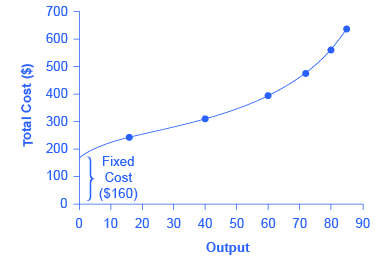
The relationship betwixt the quantity of output being produced and the cost of producing that output is shown graphically in the figure. The fixed costs are always shown as the vertical intercept of the total cost curve; that is, they are the costs incurred when output is zero so there are no variable costs.
Y'all tin see from the graph that once production starts, total costs and variable costs rise. While variable costs may initially increase at a decreasing charge per unit, at some point they begin increasing at an increasing charge per unit. This is caused by diminishing marginal returns, discussed in the chapter on Choice in a World of Scarcity, which is easiest to see with an example. As the number of barbers increases from zero to one in the table, output increases from 0 to xvi for a marginal proceeds of 16; as the number rises from one to two barbers, output increases from 16 to 40, a marginal gain of 24. From that betoken on, though, the marginal gain in output diminishes equally each additional barber is added. For instance, as the number of barbers rises from ii to iii, the marginal output gain is only twenty; and as the number rises from three to four, the marginal gain is only 12.
To sympathise the reason backside this pattern, consider that a one-man barber store is a very decorated operation. The single barber needs to practice everything: say howdy to people entering, answer the phone, cut hair, sweep up, and run the cash annals. A 2nd barber reduces the level of disruption from jumping back and along betwixt these tasks, and allows a greater sectionalization of labor and specialization. The result can exist greater increasing marginal returns. However, as other barbers are added, the advantage of each boosted barber is less, since the specialization of labor can merely go so far. The add-on of a sixth or 7th or 8th hairdresser merely to greet people at the door will have less impact than the 2nd 1 did. This is the pattern of diminishing marginal returns. Equally a outcome, the total costs of production will brainstorm to rise more than rapidly as output increases. At some point, you lot may fifty-fifty see negative returns equally the additional barbers brainstorm bumping elbows and getting in each other's fashion. In this case, the add-on of notwithstanding more barbers would actually crusade output to decrease, equally shown in the last row of Table two.
This design of diminishing marginal returns is common in production. As another case, consider the problem of irrigating a crop on a farmer's field. The plot of land is the fixed gene of production, while the h2o that tin exist added to the country is the key variable cost. As the farmer adds h2o to the land, output increases. But calculation more and more water brings smaller and smaller increases in output, until at some signal the water floods the field and actually reduces output. Diminishing marginal returns occur considering, at a given level of stock-still costs, each additional input contributes less and less to overall production.
Average Total Cost, Average Variable Cost, Marginal Cost
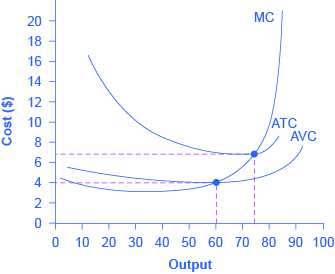
The breakdown of total costs into fixed and variable costs can provide a ground for other insights as well. The offset five columns of Table 3 duplicate the previous tabular array, but the concluding three columns show average total costs, average variable costs, and marginal costs. These new measures analyze costs on a per-unit (rather than a total) ground and are reflected in the curves shown in Figure 2.
| Labor | Quantity | Fixed Toll | Variable Cost | Total Cost | Marginal Toll | Average Total Cost | Average Variable Toll |
|---|---|---|---|---|---|---|---|
| 1 | 16 | $160 | $80 | $240 | $five.00 | $15.00 | $5.00 |
| 2 | 40 | $160 | $160 | $320 | $3.thirty | $8.00 | $four.00 |
| 3 | 60 | $160 | $240 | $400 | $iv.00 | $6.threescore | $4.00 |
| 4 | 72 | $160 | $320 | $480 | $6.60 | $half-dozen.threescore | $4.xl |
| 5 | fourscore | $160 | $400 | $560 | $ten.00 | $7.00 | $five.00 |
| half dozen | 84 | $160 | $480 | $640 | $xx.00 | $seven.sixty | $five.70 |
| Table 3. Different Types of Costs | |||||||
Average full price (sometimes referred to only as boilerplate price) is total toll divided by the quantity of output. Since the total cost of producing twoscore haircuts is $320, the average total toll for producing each of twoscore haircuts is $320/xl, or $8 per haircut. Average toll curves are typically U-shaped, equally Effigy 2 shows. Average total cost starts off relatively loftier, because at low levels of output total costs are dominated by the fixed price; mathematically, the denominator is so small that average total price is large. Average total cost and then declines, as the fixed costs are spread over an increasing quantity of output. In the average cost adding, the rising in the numerator of full costs is relatively small compared to the ascent in the denominator of quantity produced. But equally output expands withal further, the boilerplate cost begins to rise. At the right side of the average toll curve, total costs begin ascension more rapidly as diminishing returns kicking in.
Boilerplate variable cost obtained when variable price is divided by quantity of output. For example, the variable cost of producing 80 haircuts is $400, so the average variable cost is $400/80, or $5 per haircut. Note that at whatever level of output, the average variable cost bend will always prevarication below the curve for boilerplate full toll, as shown in Effigy 2. The reason is that average total cost includes average variable cost and boilerplate fixed cost. Thus, for Q = 80 haircuts, the average total price is $8 per haircut, while the average variable toll is $five per haircut. However, every bit output grows, fixed costs become relatively less important (since they do not ascension with output), so average variable cost sneaks closer to boilerplate cost.
Boilerplate total and variable costs measure the average costs of producing some quantity of output. Marginal toll is somewhat different. Marginal cost is the additional cost of producing one more unit of output. Then it is not the cost per unit of all units being produced, only only the next one (or side by side few). Marginal price can be calculated by taking the change in total cost and dividing information technology by the change in quantity. For case, as quantity produced increases from xl to 60 haircuts, total costs rising by 400 – 320, or 80. Thus, the marginal cost for each of those marginal 20 units will exist 80/20, or $4 per haircut. The marginal toll curve is generally upward-sloping, because diminishing marginal returns implies that additional units are more than plush to produce. A small range of increasing marginal returns can exist seen in the figure as a dip in the marginal cost curve before it starts rising. In that location is a point at which marginal and average costs run across, equally the following Clear it Up feature discusses.
Where exercise marginal and average costs encounter?
The marginal cost line intersects the average cost line exactly at the bottom of the average cost bend—which occurs at a quantity of 72 and cost of $6.60 in Figure 2. The reason why the intersection occurs at this signal is congenital into the economic meaning of marginal and average costs. If the marginal cost of production is beneath the boilerplate cost for producing previous units, as it is for the points to the left of where MC crosses ATC, then producing one more than additional unit of measurement will reduce average costs overall—and the ATC curve volition be downwards-sloping in this zone. Conversely, if the marginal cost of production for producing an additional unit is above the average price for producing the earlier units, as it is for points to the correct of where MC crosses ATC, then producing a marginal unit of measurement will increment average costs overall—and the ATC curve must exist up-sloping in this zone. The point of transition, betwixt where MC is pulling ATC down and where it is pulling it up, must occur at the minimum point of the ATC curve.
This idea of the marginal cost "pulling down" the average cost or "pulling up" the boilerplate toll may sound abstract, but think about information technology in terms of your ain grades. If the score on the almost contempo quiz you accept is lower than your average score on previous quizzes, then the marginal quiz pulls down your boilerplate. If your score on the about contempo quiz is college than the boilerplate on previous quizzes, the marginal quiz pulls up your average. In this aforementioned way, low marginal costs of production first pull down average costs and then higher marginal costs pull them up.
The numerical calculations behind average cost, average variable cost, and marginal cost will change from firm to firm. Still, the general patterns of these curves, and the relationships and economic intuition behind them, will not change.
Lessons from Culling Measures of Costs
Breaking down total costs into stock-still toll, marginal cost, average total price, and boilerplate variable cost is useful because each statistic offers its own insights for the business firm.
Whatever the firm's quantity of production, total revenue must exceed full costs if it is to earn a turn a profit. As explored in the chapter Choice in a Globe of Scarcity, fixed costs are often sunk costs that cannot exist recouped. In thinking about what to do next, sunk costs should typically be ignored, since this spending has already been fabricated and cannot be changed. Even so, variable costs can be changed, so they convey information about the firm'southward power to cut costs in the present and the extent to which costs will increase if production rises.
Why are full price and average cost not on the aforementioned graph?
Full cost, stock-still toll, and variable cost each reflect different aspects of the cost of production over the entire quantity of output being produced. These costs are measured in dollars. In dissimilarity, marginal cost, boilerplate cost, and average variable cost are costs per unit. In the previous example, they are measured as cost per haircut. Thus, it would not make sense to put all of these numbers on the aforementioned graph, since they are measured in different units ($ versus $ per unit of output).
It would be every bit if the vertical axis measured two dissimilar things. In improver, equally a practical matter, if they were on the same graph, the lines for marginal price, boilerplate cost, and boilerplate variable price would appear most flat against the horizontal centrality, compared to the values for full cost, fixed cost, and variable cost. Using the figures from the previous example, the total toll of producing 40 haircuts is $320. But the boilerplate cost is $320/40, or $8. If you graphed both total and boilerplate cost on the aforementioned axes, the average cost would hardly bear witness.
Average cost tells a house whether it tin can earn profits given the current price in the market. If we split up turn a profit past the quantity of output produced nosotros get average profit, also known every bit the house's profit margin. Expanding the equation for profit gives:
[latex]\brainstorm{assortment}{r @{{}={}} 50}average\;profit & \frac{profit}{quantity\;produced} \\[1em] & \frac{total\;revenue\;-\;full\;toll}{quantity\;produced} \\[1em] & \frac{full\;acquirement}{quantity\;produced}\;-\;\frac{total\;price}{quantity\;produced} \\[1em] & average\;revenue\;-\;average\;cost \cease{array}[/latex]
But notation that:
[latex]\brainstorm{array}{r @{{}={}} 50}boilerplate\;revenue & \frac{cost\;\times\;quantity\;produced}{quantity\;produced} \\[1em] & price \end{array}[/latex]
Thus:
[latex]average\;profit = cost\;-\;boilerplate\;cost[/latex]
This is the firm's profit margin. This definition implies that if the marketplace price is above average cost, average profit, and thus total turn a profit, volition be positive; if price is below average price, then profits will be negative.
The marginal toll of producing an additional unit can be compared with the marginal revenue gained past selling that additional unit to reveal whether the additional unit is adding to total turn a profit—or non. Thus, marginal cost helps producers empathize how profits would be afflicted by increasing or decreasing production.
A Variety of Cost Patterns
The pattern of costs varies amid industries and fifty-fifty amongst firms in the same industry. Some businesses accept high fixed costs, but low marginal costs. Consider, for instance, an Internet company that provides medical advice to customers. Such a company might be paid by consumers directly, or perhaps hospitals or healthcare practices might subscribe on behalf of their patients. Setting up the website, collecting the information, writing the content, and buying or leasing the reckoner infinite to handle the spider web traffic are all fixed costs that must be undertaken earlier the site tin work. However, when the website is up and running, it can provide a high quantity of service with relatively depression variable costs, like the cost of monitoring the system and updating the information. In this case, the full toll curve might starting time at a high level, considering of the high fixed costs, only then might appear close to flat, up to a large quantity of output, reflecting the low variable costs of functioning. If the website is popular, nevertheless, a large ascent in the number of visitors will overwhelm the website, and increasing output farther could require a purchase of additional computer space.
For other firms, fixed costs may exist relatively low. For example, consider firms that rake leaves in the fall or shovel snowfall off sidewalks and driveways in the winter. For stock-still costs, such firms may need niggling more than a car to send workers to homes of customers and some rakes and shovels. Still other firms may find that diminishing marginal returns set in quite sharply. If a manufacturing plant tried to run 24 hours a mean solar day, seven days a week, trivial time remains for routine maintenance of the equipment, and marginal costs can increase dramatically equally the business firm struggles to repair and supplant overworked equipment.
Every firm tin can gain insight into its task of earning profits by dividing its total costs into fixed and variable costs, and then using these calculations every bit a basis for boilerplate full price, boilerplate variable cost, and marginal cost. However, making a concluding decision nearly the turn a profit-maximizing quantity to produce and the price to charge will crave combining these perspectives on cost with an analysis of sales and acquirement, which in turn requires looking at the marketplace construction in which the firm finds itself. Before nosotros plough to the assay of market place structure in other chapters, we will analyze the firm'southward cost structure from a long-run perspective.
Key Concepts and Summary
In a brusk-run perspective, a firm'southward total costs can be divided into fixed costs, which a house must incur before producing any output, and variable costs, which the firm incurs in the act of producing. Stock-still costs are sunk costs; that is, because they are in the past and cannot be contradistinct, they should play no part in economic decisions nigh future product or pricing. Variable costs typically show diminishing marginal returns, so that the marginal cost of producing higher levels of output rises.
Marginal price is calculated by taking the change in total price (or the change in variable cost, which will be the same thing) and dividing information technology by the change in output, for each possible alter in output. Marginal costs are typically rising. A firm tin can compare marginal cost to the additional revenue information technology gains from selling some other unit to find out whether its marginal unit is adding to profit.
Average total cost is calculated by taking total toll and dividing by total output at each dissimilar level of output. Average costs are typically U-shaped on a graph. If a firm'due south boilerplate price of production is lower than the market cost, a house will be earning profits.
Average variable price is calculated by taking variable price and dividing past the full output at each level of output. Average variable costs are typically U-shaped. If a firm's average variable cost of production is lower than the market toll, and so the firm would be earning profits if stock-still costs are left out of the movie.
Cocky-Check Questions
- The WipeOut Ski Company manufactures skis for beginners. Fixed costs are $30. Fill in Table four for full cost, boilerplate variable price, average total cost, and marginal cost.
Quantity Variable Cost Stock-still Price Full Cost Average Full Price Average Variable Cost Marginal Cost 0 0 $30 one $10 $xxx two $25 $30 3 $45 $30 4 $lxx $thirty v $100 $xxx half dozen $135 $30 Table 4. - Based on your answers to the WipeOut Ski Company in Self-Check Question one, now imagine a state of affairs where the house produces a quantity of v units that information technology sells for a price of $25 each.
- What volition be the company's profits or losses?
- How can you tell at a glance whether the visitor is making or losing money at this toll by looking at average cost?
- At the given quantity and price, is the marginal unit produced adding to profits?
Review Questions
- What is the difference betwixt fixed costs and variable costs?
- Are at that place fixed costs in the long-run? Explain briefly.
- Are fixed costs also sunk costs? Explicate.
- What are diminishing marginal returns as they relate to costs?
- Which costs are measured on per-unit basis: fixed costs, average cost, average variable cost, variable costs, and marginal cost?
- How is each of the post-obit calculated: marginal cost, average total price, average variable cost?
Critical Thinking Questions
- A mutual proper noun for stock-still toll is "overhead." If you lot carve up stock-still price by the quantity of output produced, y'all go average fixed cost. Supposed stock-still cost is $1,000. What does the boilerplate fixed cost curve expect like? Apply your response to explain what "spreading the overhead" means.
- How does stock-still cost affect marginal price? Why is this relationship important?
- Boilerplate toll curves (except for average fixed price) tend to be U-shaped, decreasing and then increasing. Marginal cost curves take the same shape, though this may exist harder to see since most of the marginal cost curve is increasing. Why do you lot think that average and marginal cost curves have the aforementioned general shape?
Problems
- Return to Figure 1. What is the marginal gain in output from increasing the number of barbers from 4 to 5 and from 5 to 6? Does information technology go on the pattern of diminishing marginal returns?
- Compute the average total cost, boilerplate variable cost, and marginal cost of producing 60 and 72 haircuts. Depict the graph of the three curves between 60 and 72 haircuts.
Glossary
- average profit
- profit divided by the quantity of output produced; profit margin
- average full cost
- full cost divided by the quantity of output
- average variable cost
- variable cost divided by the quantity of output
- fixed price
- expenditure that must be made before production starts and that does not modify regardless of the level of product
- marginal price
- the additional cost of producing i more unit
- total cost
- the sum of fixed and variable costs of production
- variable price
- cost of product that increases with the quantity produced
Exercises
Answers to Self-Check Questions
-
Quantity Variable Cost Fixed Cost Total Cost Average Total Toll Boilerplate Variable Cost Marginal Price 0 0 $30 $30 – – 1 $ten $xxx $40 $10.00 $xl.00 $10 two $25 $30 $55 $12.l $27.50 $15 3 $45 $30 $75 $15.00 $25.00 $20 4 $70 $30 $100 $17.fifty $25.00 $25 5 $100 $30 $130 $20.00 $26.00 $xxx 6 $135 $30 $165 $22.50 $27.50 $35 Table five. -
- Full revenues in this example will be a quantity of five units multiplied by the price of $25/unit, which equals $125. Total costs when producing five units are $130. Thus, at this level of quantity and output the firm experiences losses (or negative profits) of $5.
- If price is less than average cost, the business firm is not making a profit. At an output of five units, the average cost is $26/unit of measurement. Thus, at a glance yous can see the firm is making losses. At a second glance, you tin can see that information technology must be losing $one for each unit produced (that is, average cost of $26/unit minus the price of $25/unit). With five units produced, this observation implies total losses of $v.
- When producing five units, marginal costs are $30/unit. Toll is $25/unit. Thus, the marginal unit is non adding to profits, but is actually subtracting from profits, which suggests that the firm should reduce its quantity produced.
Source: https://opentextbc.ca/principlesofeconomics/chapter/7-2-the-structure-of-costs-in-the-short-run/
0 Response to "refer to figure 13-3. what is the marginal revenue of the sixth unit of output? $4 $5 $9 $54"
Post a Comment