Cite an Example of Fine Arts Influence on Visual Media
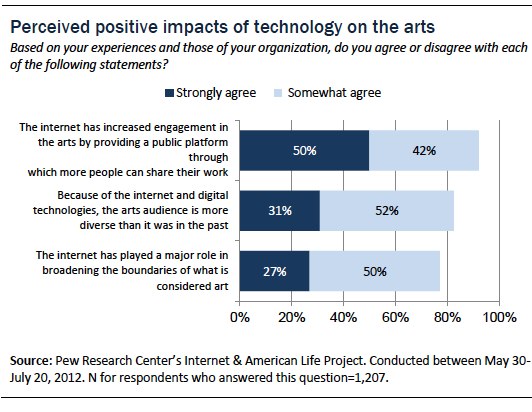
The arts organizations represented in the survey tend to hold with the notions that the internet and social media have "increased engagement" and made fine art a more participatory feel, and that they have helped make "arts audiences more various." They likewise tend to agree that the internet has "played a major role in broadening the boundaries of what is considered art."
Still at the aforementioned fourth dimension, the majority of arts organizations surveyed too idea that mobile devices, ringing cell phones and texting create "significant disruptions" to live performances, and that technology contributes to an expectation that "all digital content should be free." Survey respondents were split regarding their opinions of whether applied science had negatively impacted audience attention spans for live performance, just they uniformly disconcur that information technology has "diluted the arts" by opening new pathways to arts participation and arts criticism.
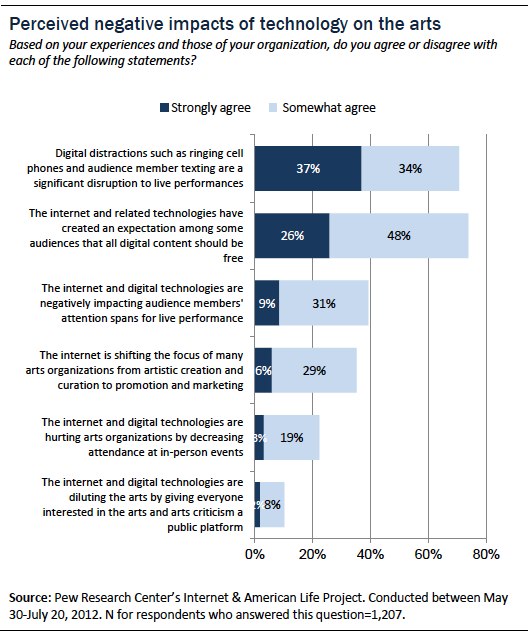
Despite comments in open-ended responses, simply 35% of respondents concur with the argument that the internet has shifted arts organizations' focus towards marketing and promotion, and even fewer (22%) thought that the net and its countless offerings are leading to a subtract in attendance at in-person events.
Predicting impacts of applied science and social media
Asked to forecast the bear on that technology and social media volition have on the field as a whole in the coming years, respondents mentioned everything from practical implications to broader, soul-searching ideas about the future of creativity.
From a applied standpoint, many organizations state that technology will make them more efficient:
[We have the] ability to serve more people and at a lower cost.
The internet makes it possible for our arrangement to market ourselves more finer through online advertising, web log presences, and social media exchanges. We accept been able to subtract our budgets and increment revenue by utilizing online resources effectively.
It is also greatly facilitating their ability to volume talent, and to know what to expect:
For arts programmers, the access to loftier quality media to review artists in advance of assessing them live has been a huge step forward. Spotify alone has made it so much easier to get a first impression of an artist–no more waiting for printing kits, accessing only what they've posted on their websites, etc.
Others commented on how applied science is changing the behavior of the ticket-buying public:
Last-minute ticket-buying and the trend away from traditional subscription packages will probably continue, as the internet has freed people up from having to plan for most effect attendance far in advance. This will impact the predictability of revenue. On the positive side, social media has been a wonderful tool for word-of-oral cavity marketing.
While it is incommunicable to know what internet and digital technologies volition exist like in x years, the tendency of more than information communicated more quickly to a more finely targeted audience with more than firsthand feedback from the recipient is likely to continue. We believe that this leads people to delay their decision-making virtually how they will spend their leisure fourth dimension. For our field, this has generally meant a decline in subscriptions, a decrease in advance ticket sales, and an increase in last-infinitesimal box role sales.
Moving beyond the practical, i of the prevailing positive themes is that engineering science increases – and volition continue to increase – access to the arts. In some cases, technology is simply seen as a manner to improve marketing and communication to get more "butts in seats," but many respondents noted its ability to broaden and deepen the audience experience.
Technology is helping them introduce more audiences to art:
The digital world is a very populist force, leveling the world between rich and poor, educated and uneducated. In our example, an organization with a name like "Historical Guild" has an invisible shield that bounces people who are below median income, practice not concur college degrees, who hold blue neckband jobs, who are a racial or cultural minority, off. The ubiquity of the computer, whether through your home motorcar, schoolhouse, or local library, means that all of those things that crusade discomfort don't matter. That is a big bargain!
It has extended our visibility to many isolated individuals who may never have heard about our services, explored the artform, or who may accept financial barriers to membership. Nosotros prove to them every day what we practice, rather than wait them to find a printed almanac report and plan summary. Social media are concrete and firsthand examples of our living customs in activity.
Engineering science is besides helping arts organizations extend their bear on, far beyond a one-fourth dimension performance or result:
The internet and digital media provide an amazing opportunity for arts organizations to extend the bear on of the arts. A live performance tin be complemented greatly by opportunities for further appointment and education, and the ability to share data online maximizes our ability to provide these opportunities at a more in-scale investment ratio. We can achieve many more people with an article or video than with a one-fourth dimension lecture, for example.
Nosotros are able to provide artwork that dates back more than than 25 years to the communities we have worked with over the years. For many, these archives represent the simply media history of their community. The use of the net has deepened and expanded the admission for our constituencies that are frequently transitional, without a landbase, or have been historically isolated due to geography.
Applied science is increasing access to the arts by breaking geographic constraints:
I think that it volition greatly meliorate accessibility to the arts field – from a monetary standpoint and from a logistical standpoint. People who live outside of urban areas will exist able to feel performances that are somewhat limited to large urban areas. Arts organizations will need to reconsider the level/type of interaction with their audience.
Technology is helping organizations reach more diverse communities – even on a global calibration:
The greatest impact will exist the ability for non-profit organizations to share educational content and stimulating art and performances worldwide. It will also spark conversations betwixt various communities and help individuals develop a greater understanding – and hopefully, a life-long appreciation for the arts.
The cyberspace will enable the performing arts to achieve beyond a local audition, promote tourism, and make cultural arts created within a region accessible to the nation – and globe.
Engineering is making information technology possible to create community effectually a piece of art:
At that place is a powerful opportunity for the arts to create communities around performances, shows, exhibitions and their themes and history. For example, a Broadway testify like 'Next to Normal' could (and probably has) created communities to hash out and share resources on mental illness.
Some organizations enthusiastically talk well-nigh the democratization of art and creation, while others expressed excitement nearly the challenge of meeting new demands and expectations:
Continuing the transition from passive to participation, from hierarchical to democratic, from traditional media to online media, from single fine art-form to inter-disciplinary.
The possibility to profoundly expand and create a more diverse audience is very heady considering traditionally our audience has been older and whiter than the area we live in. Increasingly, nosotros're seeing some of our content getting traction in surprising nooks and crannies of the internet – which definitely means a shifting audition. The challenge will be for that audience to identify our content with the creators and the establishment, and not simply have information technology exist as more than entertainment or noise out on the internet. In the adjacent couple of years, the part of mobile devices volition only go on to shift how people curate their ain experience and appoint with artistic content. In radio, this presents an exciting AND daunting challenge in terms of our funding structure and station loyalty.
The challenges that digital technology present
These arts organizations realize that with these benefits come up drawbacks. While digital technologies have led to the creation of ever-more dazzling tools and apps, many arts organizations worry about the long term result on audiences, the field, and their very mission.
A number of respondents worry well-nigh meeting increased audience expectations:
People will have college expectations for a live event. For audiences to invest the fourth dimension and effort of going to a live functioning, the work they meet will have to be more than engaging and of higher quality. Events will have to exist more social and allow for greater participation and behind-the-scenes access. The event spaces will have to be more cute, more comfortable, more inviting and more attainable.
The audience has already moved from "arts omnipresence as an event" to "arts attendance every bit an experience." This desire for a full-range of positive experience from ticket buy, to travel, to parking, to treatment at the space, to quality of performance, to get out – this will only increase over the side by side 10 years.
The greatest touch on of the net on independent publishers will exist audience expectations. Audiences will expect everything to be bachelor digitally, and will require an engaging experience instead of a static i.
Some point out the problem of meeting audience expectations on a express budget:
Managing expectations. The net and digital technologies are powerful tools. The public expects content to be costless. There is a lack of sensation of the resources (funding and staff) that it takes to manage and preserve digital content. These costs will need to exist passed on to users.
Others limited concern that the endeavor to meet audition expectations will influence artistic choices, fifty-fifty entire fine art forms:
Some ideas cannot be condensed into 140 characters or less. I hope technologies do not negatively affect the playwright. I promise the playwright does non write solely for a Twitter generation.
Live performance will be macerated. Younger people don't want to show up at a specific time, specific place for alive performance — they desire to download music at their own convenience. The power of live performance is lost and the civic convening – the community edifice is lost.
Some arts organizations take recognized this change, and are doing their best to adjust:
I believe digital technologies are here to stay, and we as an artform should embrace them and learn how to piece of work alongside them. Nosotros provide scripts to those sitting in our tweetseats, so they get the quotes right. We must work alongside or face alienating them.
I believe that audiences will continue to have shorter and shorter attending spans and will insist upon being able to utilise smartphones and other devices in the context of a performance. As an industry, we should terminate fighting and try to discover ways to incorporate that reality into our daily lives.
We will need to get much less tied to live, in person programming and certainly less ties to anchored seats in concert halls. Programming volition need to incorporate much more personal involvement by the consumers or they will not exist interested in engaging.
A number of respondents worried about audiences' decreasing attention spans, and the long-term bear upon on the field:
Equally attention spans subtract, programming of longer works (due east.chiliad., Beethoven's Symphony #9) volition go more problematic. Every bit we movement forward, we may need to consider ways to embrace the digital, connected world to better appoint live audiences or run the take chances of making alive music performances irrelevant.
The greatest impact could be the expansion of our audiences, but the worst bear on is the attention span of the moment of interaction. I worry that it may shorten our artforms' operation times.
Technology has blurred the lines between commercial entertainment and noncommercial art, forcing arts organizations to more than directly compete with all other forms of amusement:
Basically, nosotros are competing for the "entertainment slot" in people's schedules, and the more than entertainment they can get via HD TV, Netflix, Video Games, etc., the less time they have for alive performances, which as well entails making an try to get to the venue (as opposed to slumping on the couch in front of the HD screen). Also, movies, video games, etc., are both more than convenient and cheaper than alive performances.
It has too blurred the lines betwixt a virtual and real experience:
Equally the realism of participatory digital entertainment (video games, etc.) and the immersion ability of non-participatory digital entertainment (3D movies, etc.) increases, it threatens the elements that make the live arts unique–the sense of immediacy, immersion, and personal interaction with the art. We've long hung fast to the belief that there'due south nothing like a live experience, merely digital entertainment is getting closer and closer to replicating that experience, and live theatre will struggle to compete with the former's convenience and toll.
Some respondents addressed issues specific to their field or field of study. Motion picture and cinema organizations talk about the pressure they face to preserve the "specialness" of the big screen when on-demand dwelling house viewing is already prevalent:
Equally a cinema approaching our 5th ceremony, nosotros have seen meaning audition growth in spite of the fact that many of the films we play are beingness released "day and date" on-need. While streaming and piracy are increasing, we've been able to deliver the bulletin that seeing films on the big screen with an audience is a singular, of import cultural experience. I tin't emphasize the importance of the internet and social media in our marketing efforts enough. It'southward most certainly a net positive value.
As a picture exhibitor, our challenge is to become through the digital convergence for project and exhibition, a supremely costly alter that doesn't even have a long-range viability (these systems will have to exist upgraded and/or changed every 3-v years). Finding the revenue for these digital systems is an enormous claiming and threat to our ongoing activities.
Others working in picture show worry that the quality and quantity of movies will diminish:
In the field of motion-picture show product and distribution, more than internet and digital access will upshot in far fewer movie theaters, as audiences have greater admission in their homes to the medium. Already, as marketing dollars become more limited for films, production companies are shortening the movie lifespan in a movie theater and moving them to digital and television media sooner and sooner.
Organizations in the literary book tradition are facing similar challenges with ebooks:
Literature and the book are being very impacted by digital technologies due to the growing popularity of ebooks and to the influence of huge online booksellers like Amazon. At that place are both good and bad effects associated with these technologies. These days books are more easily attainable to a greater number of people still it is hard for the volume manufacture to produce a sustainable amount of income whether for individuals and for organizations. It is crucial that the public understand the importance of supporting nonprofit literary orgs, publishers, independent bookstores, libraries and other supporters of volume culture and in turn it is crucial for foundations and government to provide this support.
All literary magazines are in peril right now, so if magazines such as ours continue to exist it will be because of a prototype shift in how literature is funded as an fine art form in the U.Due south. I am loathe to believe that impress publications will cease to exist because they are still more cute, but all publishers will eventually have to create simultaneous digital and print editions, I imagine, which will make the whole enterprise more expensive.
Some respondents worry that these disruptive technological and cultural forces volition make information technology harder for some big scale artforms to survive:
I believe that the more expensive arts producers – symphony orchestras, for example – will find information technology more than difficult to draw plenty audition to continue in the same manner they've operated for the past decades. Smaller groups will find it easier to adjust considering they're more than flexible (they don't require a big stage and hall). I am very concerned virtually losing some of the greatest music ever written — symphonic music — for this reason.
Others pointed to innovative experiments — similar the Metropolitan Opera'south performances in picture show theatres — as an instance of what large institutions with funding tin can practice:
For opera, it has made it more than accessible, by providing low-cost functioning broadcast of Met performances. This has increased the potential audience for our alive performances. It is our companies responsible to promote effectively to those audiences. Overall I believe the issue is positive.
Museums take a unique perspective on technology'due south bear on. It has profoundly improved their cataloging efforts, simply some worry that it will eventually reduce audience involvement in the "real thing":
It volition radically shift the style in which we catalog and share information about collections; the museum as less the all knowing potency and more the conduit for rich institution-driven AND user-driven data. Information technology volition also let regional collections the ability to link to like collections worldwide – as such our local collections can be recontextualize and made meaningful in ways not possible without linked data and semantic spider web technologies.
Digital technology and the resulting accessibility of data and images, while fostering accessibility of collections online, have the negative impact of diluting the desire of individuals to visit the museum to see works of art in person.
A number of organizations mentioned the demise of trusted critics and filters, which has happened every bit print media — especially local newspapers — have cutting back on staff and struggled with decreased ad acquirement as part of this digital transition. Without critics, they worry about how arts audiences will gauge quality:
Digital technologies accept essentially fabricated it impossible for book critics to support themselves in traditional ways; maybe the next 10 years will bring the shift of book criticism to academic world, where salaries are paid for teaching, and reviewing is a secondary activeness. 20-five years ago, working critics had full time salaries from newspapers, magazines, other publications. Today there are only a handful of critics able to exercise this.
Our principal business for the literary arts is the increasing "validity" of self-publication among reviewers, readers, and writers. Online publishing and book sales through Amazon (for example) contribute to this problem. If at that place are no gatekeepers, information technology will become fifty-fifty more difficult to draw attention to works of genuinely high quality.
For some, the absence of critics and mainstream media previews of arts events means that arts organizations are shouldering an even greater brunt:
The demise of daily and weekly newspapers and the increasing fragmentation of traditional radio and television receiver media outlets combined with the increasing consolidation of media ownership due to revised FCC regulations has marginalized arts coverage and criticism to a point where it no longer plays a part in the larger borough conversation. Hence, it is condign increasingly difficult to reach and engage potential audience members and arts participants, and has shifted the unabridged burden (and costs) to arts organizations that are sick equipped and unprepared to both appoint in their traditional function (i.e., support the creation and presentation of fine art piece of work) also as build support structures to take the identify of traditional media organizations.
Some responses addressed the future of artists themselves. There is recognition that today's artists must as well be entrepreneurs:
Digital technologies volition level the playing field for all and old school, professional artists will be left behind. It is the advent of the apprentice. For those who are savvy and ahead of the curve, there is money to be made if the content is stiff. It means the complete reversal of a contributed based model founded on single funding sources and moves toward an earned revenue model and crowd sourced funding. Now more than than ever, artists demand to exist entrepreneurs and not merely artists. Y'all can't survive now as an creative person unless you have a strong business model.
Notwithstanding others worried openly about how artists will brand a living as traditional revenue streams shift or disappear:
[The internet] is condign the major distribution platform for documentaries, which is what we do. The DVD volition be gone in 10 years. Artists are going to struggle to monetize their piece of work on the Web.
Access volition exist good for educational purposes and to increase awareness of the arts especially historical material in performance of all types. Nevertheless, issues of copyright and payment for that material, such equally in apps and in streaming or downloading, are murky and hard to navigate for artists themselves as to value and fairness of payments to the artist for original content.
There were likewise some contemplative responses about the bear on of engineering science on culture. Ane respondent pointed out that the ability to collaborate globally could lead to more cultural homogeneity while another worried about the future of non-digitized fine art:
Digital technologies allows for students and artists all over the world to be inspired by one another. In some ways this is fantastic, in other means, this breaks down the cultural differences that is so beautiful well-nigh having multiple countries involved in an fine art course.
Materials we have that aren't available digitally will be lost from the man tape.
Finally, several respondents summed upwards the bug facing arts organizations, connecting the challenges of coming together audience expectations with limited funding options:
Attendance at live performances will favor more fervent fans and those with dispensable incomes who reside in cities, and the increased prevalence of simulcasts and livestreams will alter the viewing experience while also making it more than democratic and affordable. Audiences volition look the digital presence of institutions to be well maintained and curated.
Organizations will continue to need to suit and comprise digital technologies into their programming. This will be a good thing for art consumers and patrons by increasing accessibility and improving collaboration. At the aforementioned time, organizations will struggle with funding to keep up with technology. Funders so rarely fund some of the infrastructure necessary to create top-notch digital programming, and that volition be a major struggle.
Survey results reveal that on a purely practical level, the internet, digital technologies and social media are powerful tools, giving arts organizations new ways to promote events, engage with audiences, reach new patrons, and extend the life and scope of their work. "We tin can reach more patrons, more frequently, for less coin," said ane respondent. "That's been a huge change in the 30 years I've been in the business."
But, technology has also disrupted much of the traditional fine art world; it has changed audience expectations, put more pressure on arts organizations to participate actively in social media, and even undercut some arts groups' missions and revenue streams.
Across the practical, the internet and social media provide these arts organizations with wide cultural opportunities. Comments in this survey reveal an array of innovative ways that arts organizations are using technology to introduce new audiences to their work, betrayal more of their collections, provide deeper context around plays and exhibits, and break downwardly cultural and geographic barriers that, to this indicate, accept made information technology difficult for some members of the public to participate. Their responses suggest that the majority of these arts organizations, with plenty funding and foresight, are eager to use the new digitals tools to sustain and amplify their mission-driven work.
Source: https://www.pewresearch.org/internet/2013/01/04/section-6-overall-impact-of-technology-on-the-arts/
0 Response to "Cite an Example of Fine Arts Influence on Visual Media"
Post a Comment