Can You Be Evicted for Late Fees in California
NOTE: Between October one, 2021, and March 31, 2022, a landlord who seeks to adios a tenant for failure to pay rent that was due and unpaid betwixt March i, 2022 and March 31, 2022 on a charter that began before October i, 2021, must apply for rental aid earlier the court will consequence a summons.
QUICK INFO
Steps of the eviction process in California:
- Notice is posted to correct the issue/vacate.
- If uncured and tenant remains, petition is filed and served.
- Answer is filed.
- Hearing is held and judgment issued.
- If granted, writ of execution is posted.
- Possession of property is returned to landlord.
Timeline. Evicting a tenant in California can take about five to viii weeks (or more) depending on the reason for the eviction, and how (or how chop-chop) the tenant was served the summons and complaint. If tenants request a stay of execution, the process tin can have longer (read more).
Questions? To conversation with a California eviction attorney, Click here
Introduction. California has specific rules and regulations for eviction cases. Legally a landlord tin evict a tenant in California past filing an eviction lawsuit with the court and receiving a court order assuasive the eviction to occur. Beneath are the grounds for eviction in California.
Step 1: Observe is Posted
In California, there must be grounds for eviction in order to keep with the courtroom. Landlords in California can brainstorm the eviction process for several reasons, including:
- Nonpayment of Rent – Once rent is past due, the tenant must be given the option to pay rent in order to avoid eviction.
- Violation of Lease Terms / Rental Agreement – If a tenant violates a provision of a written charter/rental agreement, the landlord must give the tenant the opportunity to correct the effect (if curable) before moving forward with the eviction procedure.
- No Lease / Stop of Lease Term (Tenant at Volition) – Landlords in rent-controlled cities cannot adios tenants once the rental period/term of the lease has ended without some other crusade; in all other areas, notice is only required for month-to-calendar month tenancies.
- Foreclosure of Rental Belongings – If the rental property is being foreclosed upon, and the tenancy will not exist connected, landlords are required to requite written notice prior to evicting the tenant.
- Illegal Activity – If a tenant or any other occupant of the rental unit is engaged in illegal activity, discover must be served on the tenant before the landlord can evict the tenant.
- Retaliatory Evictions. It is illegal for a landlord to evict a tenant for lament to the landlord or to the appropriate local or government bureau regarding the property. It is likewise illegal for a landlord to adios a tenant for joining, supporting, or organizing a tenant arrangement or wedlock.
- Evicting a Squatter. If the individual occupying the property did not have the permission of the landlord when initially moving in, does not accept a lease (or verbal understanding) and has no history of paying rent, then a landlord/tenant relationship may not be established. Equally a issue, the normal eviction process may not be applicable (read more than).
Each possible ground for eviction has its own rules for how the process starts.
Eviction Process for Nonpayment of Hire
A landlord is allowed to adios a tenant for declining to pay rent on time.
According to California law, rent is tardily the day after it's due. Any grace periods are addressed in the charter/rental agreement.
Once hire is past due, the landlord must provide a 3-Day Notice to Pay if the landlord wants to pursue an eviction case with the courtroom. This notice gives the tenant the option to pay the past due amount in full within three days in order to avoid eviction.
However, the eviction observe must not include whatever amount owed other than rent (like tardily fees, interest, etc.).
If the tenant does not pay the rent due by the cease of the detect period and remains on the holding, the landlord may proceed with the eviction process.
Eviction Process for Violation of Lease Terms / Rental Agreement
 A tenant tin exist evicted in California if they practise not uphold their responsibilities and obligations under the terms of a written charter/rental agreement.
California landlords must provide tenants with a 3-Day Notice to Comply giving the tenant three days to right or otherwise known every bit "cure" the issue to avert eviction.
Typical lease violations under this category could include things like having a pet when there is a specific no-pet policy, negligently or deliberately damaging the rental holding, or having likewise many people residing in the rental unit of measurement.
Some violations may not be curable, such as "waste" (causing property damage) or not-criminal nuisances. Note that illegal activity is not included in this category.
If the tenant remains on the premises later on the notice period, the landlord may continue with the eviction process.
Eviction Process for No Charter / End of Lease
In the state of California, landlords in rent-controlled cities are not allowed to terminate a tenancy without crusade; therefore, cannot evict tenants simply because the rental menses has ended.
In all other areas, if tenants "holdover," or stay in the rental property after the rental term has expired, and then the landlord may pursue an eviction action. Notice is needed prior to eviction except for the post-obit situations:
- Expired fixed-term leases; or
- If the rental unit is part of a job parcel, and the tenant loses the job or quits.
For all calendar month-to-month tenants, landlords are required to give a charter termination notice before evicting them. In California, landlords must either give 30 or 60 days' detect this is dependent on how long the month-to-month tenant has lived in the rental unit.
- Less Than Ane Yr – If a month-to-month tenant has lived in the rental unit for less than i year, a landlord must provide the tenant with a 30-Day Notice to Quit.
- Ane Year or More – If a month-to-month tenant has lived in the rental unit for a year or more than, the landlord must provide the tenant with a threescore-Day Observe to Quit.
Where no notice is needed, a landlord may file an eviction action directly with the court without giving a tenant written notice beforehand.
For month-to-month tenancies, if the tenant remains on the holding after the notice period expires, the landlord may proceed with the eviction procedure.
Eviction Process for Foreclosure of Rental Property
A tenant can be evicted in California if the rental property is being foreclosed upon, and the tenancy will not be connected.
For rental property foreclosures, the landlord is required to give tenants ninety days' written notice prior to first an eviction activity.
Tenants being evicted due to auction or foreclosure must move out, and do not have the option to "cure" an event in society to stay.
If the tenant continues to remain on the property after the notice flow expires, the landlord may proceed with the eviction process.
Eviction Process for Illegal Activity
Tenants of a rental unit who are involved in illegal activity must exist given 3 days' notice before the landlord tin go on with an eviction action.
Illegal activity includes criminal threats, criminal activity, unlawful business activity (i.e. prostitution, using the rental unit as a business concern if that'due south prohibited in the lease, etc.), and criminal nuisances such every bit:
- Illegal firearm activity
- Illegal drug activeness
- Dogfighting or cockfighting
If the tenant remains on the premises after the detect period expires, the landlord may proceed with the eviction process.
Step 2: Petition is Filed and Served
As the side by side step in the eviction procedure, California landlords must file a complaint in the appropriate court. In California, this tin can cost between $385 and $435 in filing fees and an additional $40 to consequence a writ of execution.
The summons and eviction complaint can be served on the tenant by anyone who is at to the lowest degree xviii years old and non part of the case. The summons and complaint shall be served by a align, sheriff, or registered process server. The landlord must have the tenant served within sixty days of filing the complaint, or the instance could be dismissed past the court.
The summons and complaint may be served by one of the following methods:
- Giving a copy of the summons and complaint to the tenant in person;
- Leaving a copy of the summons and complaint with the person in charge during normal business hours at the tenant'due south identify of work and mailing a copy of the summons and complaint by outset-class mail; or
- Posting a copy of the summons and complaint in a conspicuous place on the rental unit.
If the summons and complaint are left with someone other than the tenant, or posted on the rental property, then a copy must as well be mailed to the tenant in club for service to be considered "complete."
Once the summons and complaint have been served, the tenant has a chance to respond to the complaint.
 Within sixty days. The eviction action could be dismissed if the landlord doesn't serve tenant inside threescore days of filing the complaint.
Stride iii: Answer is Filed
In California, tenants are not required to file a formal, written respond to an eviction complaint; however, a landlord is required to wait out the legally required "answer period" before proceeding with the eviction process.
If the tenant doesn't respond, the court may event a default judgment in favor of the landlord.
Tenants who were served with the summons and complaint in person take v business concern days to answer to the complaint prior to a court hearing.
For all other types of service, the tenant has five days plus the additional 10 days required for service past mail service to exist considered "consummate," for a total of xv days to reply.
Subsequently the advisable time has expired, the landlord then has iii options:
- If the tenant failed to respond, the landlord can inquire for a default judgment without having to go to a courtroom hearing, which could take a few days to a few weeks, depending on the judicial officeholder'south schedule.
- If the tenant failed to respond, the landlord tin get an immediate order of possession from the clerk of courtroom'due south office. It is of import to note that this tin only be done if the landlord is non request for back rent/other monies owed.
- If the tenant did respond, the landlord must file a request for a hearing, asking the court to fix a hearing appointment for the eviction.
Both the default judgment and the order of possession bypass the hearing; therefore, the tenant will not have the opportunity to nowadays their case for why they should exist allowed to remain in the rental unit.
If the tenant does file a written respond, the eviction process shall go on with a hearing.
5-15 days, depending how the tenant was served with the summons and complaint.
Step 4: Court Hearing and Judgment
Once the landlord files a request for hearing, the eviction hearing volition be scheduled within 20 days of the date the request was filed.
Either the landlord or tenant could possibly asking an extension. The decision is granted or denied by the judicial officer.
If the approximate rules in favor of the landlord, a writ of execution shall be issued and the eviction procedure will proceed.
In California, filing an appeal will not stop the eviction. The only way a tenant can end an eviction is to request a stay of execution afterwards receiving the writ of execution in accord with Step 5 below.
Approximately 20 days. The hearing will be scheduled for a date within 20 days of the date the asking for hearing was filed by the landlord.
Step 5: Writ of Execution Is Issued
The writ of execution is the tenant'south final notice to leave the premises and allows the tenant the opportunity to remove their holding before the sheriff returns to the property to forcibly remove the tenant.
If the courtroom has ruled in the landlord's favor, the landlord will ask the court to issue a writ of execution and shall be issued at the hearing.
A few hours to a few days. The landlord must request the writ of execution, but it can be issued the aforementioned day as the hearing.
Step 6: Possession of Property is Returned
Tenants take 5 days to motility out once they accept been served with a copy of the writ of execution. If a tenant does non motility out within that period, the sheriff will return and forcibly remove them.
It's possible for tenants to request a stay of execution, which would filibuster the eviction for an boosted 40 days. If granted by the court, this will just put off the eviction, non prevent information technology, and the tenant will still need to move out after the twoscore days has ended.
Five days. The tenant has v days to move out of the rental unit after beingness served with the writ of execution. This procedure can be delayed past upwards to xl additional days if a stay is requested.
California Eviction Process Timeline
Below is a summary of the aspects outside of the landlord'due south control that dictate the amount of time it takes to evict a tenant in California. With that beingness said, these estimates can vary greatly, and some fourth dimension periods may non include weekends or legal holidays.
- Initial Notice Period – Between 3 and 90 days, depending on the reason for eviction.
- Issuance/Service of Summons and Petition – Inside sixty days of filing the complaint.
- Respond is Filed – five-15 days, depending on how the tenant was served with the summons and complaint.
- Courtroom Hearing and Ruling on the Eviction – Approximately xx days subsequently the request for hearing is filed.
- Issuance of Writ of Execution – A few hours to a few days.
- Render of Possession – V days, unless a 40-day stay is granted.
Questions? To chat with a California eviction attorney, Click here
Additional Information
Single Lodger in a Individual Residence. A single tenant who lives in a room in a habitation where the owner also resides is considered a "lodger." The owner has the right to adios the lodger without using formal eviction proceedings. The owner shall requite the unmarried lodger written notice to leave the premises. The observe time frame must be the aforementioned as the number of days betwixt rent payments (e.g. xxx days). Later on proper discover is given to the lodger, the lodger must take all of their personal possessions and leave the premises.
Flowchart of California Eviction Process
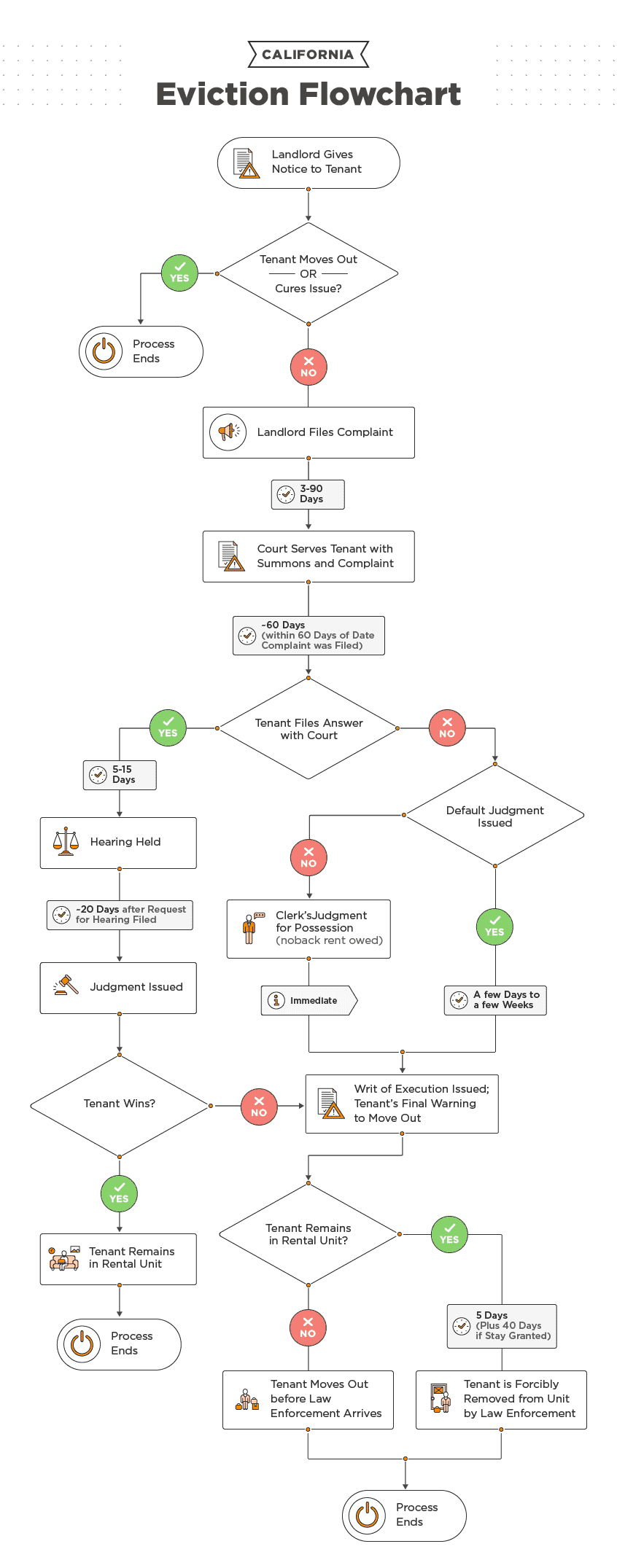
For additional questions about the eviction procedure in California, please refer to the official state legislation, California Civil Code §§1940-1954 and 3479-3486.v and the California Lawmaking of Ceremonious Procedure, §§415.10,715, and 1159-1179a,for more information.
Sources
- 1 CA Code of Civ Proc §1161 (2019)
-
(2)…after default in the payment of rent…and 3 days' discover, excluding Saturdays and Sundays and other judicial holidays, in writing, requiring its payment …or possession of the property, shall have been served upon him or her…
- ii CA Code of Civ Proc §1161 (2019)
-
(iii)…after a neglect or failure to perform other weather condition or covenants of the charter or agreement under which the property is held…and three days' notice, excluding Saturdays and Sundays and other judicial holidays, in writing, requiring the performance of such atmospheric condition or covenants, or the possession of the holding, shall have been served upon him or her…
- 3 CA Civ Lawmaking §1946.1 (2019)
-
(b) An owner of a residential dwelling house…shall give notice at least 60 days prior to the proposed date of termination. (c) Nevertheless subdivision (b), an owner of a residential dwelling…shall give find at least 30 days prior to the proposed date of termination if whatever tenant or resident has resided in the abode for less than 1 year.
- 4 CA Code of Civ Proc §1161b (2019)
-
(a)…a tenant or subtenant in possession of a rental housing unit of measurement under a month-to-month lease or periodic tenancy…shall exist given 90 days' written notice to quit…(b)…tenants or subtenants…under a fixed-term residential lease…shall survive foreclosure, except that the tenancy may be terminated upon 90 days' written observe to quit…
- 5 CA Code of Civ Proc §1161 (2019)
-
4…committing waste material…or maintaining, committing, or permitting the maintenance or commission of a nuisance…or using the premises for an unlawful purpose, thereby terminates the lease, and the landlord…shall upon service of three days' notice to quit upon the person or persons in possession, be entitled to restitution of possession of the demised bounds under this chapter.
- 6 CA Code of Civ Proc §1161 (2019)
-
4…a person who commits or maintains a public nuisance as described in Section 3482.viii of the Civil Code, or who commits an criminal offense described in subdivision (c) of Section 3485 of the Civil Code, or subdivision (c) of Section 3486 of the Civil Code…shall be deemed to accept committed a nuisance upon the bounds.
- seven CA Civ Code §3485 (2019)
-
c)…the illegal apply, industry, causing to be manufactured, importation, possession, possession for sale, sale, furnishing, or giving away of any of the following:
(1) A firearm…(2)…ammunition…(3) Whatever assault weapon…(4) Any .l BMG rifle…(5) Whatsoever tear gas weapon… - 8 CA Civ Code §3486(2019)
-
(c)…the manufacture, tillage, importation into the state, transportation, possession, possession for sale, auction, furnishing, administering, or giving abroad, or providing a place to use or fortification of a identify involving, cocaine, phencyclidine, heroin, methamphetamine, or any other controlled substance…
- nine CA Civ Lawmaking §3482.8 (2019)
-
Any building or belongings used for the purpose of willfully conducting dogfighting in violation of Section 597.5 of the Penal Code or cockfighting in violation of subdivision (b) of Section 597b of the Penal Code is a public nuisance.
- 10 CA Code of Civ Proc §1167.1 (2019)
-
If proof of service of the summons has not been filed within 60 days of the complaint'due south filing, the court may dismiss the action without prejudice.
- xi CA Lawmaking of Civ Proc §415.10 (2019)
-
A summons may be served by personal commitment of a copy of the summons and of the complaint to the person to be served.
- 12 CA Code of Civ Proc §415.20 (2019)
-
b) If a copy…cannot…be personally delivered…a summons may exist served by leaving a copy at the person's…usual place of abode, usual place of business organisation…in the presence of a competent fellow member of the household or a person plainly in charge of his or her…identify of business organization…and past mailing a copy of the summons and of the complaint by commencement-class mail service…
- 13 CA Code of Civ Proc §415.45 (2019)
-
a) A summons…may be served by posting if…it appears to the satisfaction of the courtroom…that the party to be served cannot with reasonable diligence be served in whatsoever manner specified in this article…(b) The court shall order…that a copy of the summons and of the complaint be forthwith mailed past certified post to such political party at his last known address.
- 14 CA Code of Civ Proc §1167 (2019)
-
(a)…the defendant's response shall exist filed within five days, excluding Saturdays and Sundays and other judicial holidays, after the complaint is served upon him or her.
- fifteen CA Lawmaking of Civ Proc §415.20 (2019)
-
(b)…Service of a summons in this mode is deemed complete on the 10th twenty-four hours afterward the mailing.
- 16 CA Code of Civ Proc §1170.v (2019)
-
(a) If the accused appears pursuant to Section 1170, trial of the proceeding shall be held not later on than the 20th day following the engagement that the asking to set the time of the trial is made. Judgment shall be entered thereon and, if the plaintiff prevails, a writ of execution shall be issued immediately by the court upon the asking of the plaintiff.
- 17 CA Lawmaking of Civ Proc §715.10 (2019)
-
2)…if the existent property is non vacated within five days from the date of service of a copy of the writ on the occupant or…within five days from the date a copy of the writ is served on the judgment debtor, the levying officer will remove the occupants from the real property and place the judgment creditor in possession.
Source: https://ipropertymanagement.com/laws/california-eviction-process
0 Response to "Can You Be Evicted for Late Fees in California"
Post a Comment